
In this article
Walk into most kids’ playrooms today and you’ll find bins overflowing, shelves sagging under stuffed animals, and toys scattered across every surface. It’s not because parents are careless — it’s because we love our kids, birthdays and holidays keep happening, and grandparents love to spoil. But here’s something that might surprise you: all that abundance may actually be working against your child, not for them.
Multiple studies and child development experts have landed on the same conclusion — when kids have fewer toys, they play longer, play deeper, and play more creatively. Let’s talk about why that happens, and what you can actually do about it without feeling like the toy police.
The Research Behind It
One of the most well-known studies on this topic came out of the University of Toledo, where researchers observed toddlers between 18 and 30 months old during free-play sessions. Some children played in a room with just four toys; others played in a room with sixteen. The results were striking — kids in the four-toy room played with each item roughly twice as long, and interacted with their toys in far more varied, imaginative ways. Instead of just tipping or stacking a toy, they’d start feeding it, hiding it, or inventing a whole scenario around it.
The researchers described this as “higher quality play” — meaning deeper focus, more sustained attention, and more creative use of the toy itself. When kids had sixteen toys to choose from, all that abundance became a distraction rather than an invitation to explore.
Oxford researcher Kathy Sylva reached a similar conclusion after studying thousands of children between the ages of three and five. Her work found that when kids are surrounded by too many toys, there’s a real “distraction element” — attention scatters, and it becomes harder for children to settle into meaningful play or learning. Interestingly, her research also found that children with fewer toys, whose parents spent more time actively reading, singing, and playing with them, actually outperformed kids from more toy-abundant, materially advantaged households.
Why This Happens: Exploration Mode vs. Play Mode
There’s a helpful way to think about how kids interact with a new toy, described by pediatric psychologists: children move through two stages. First comes exploration — the “what does this toy do?” phase, where a child is essentially figuring out the mechanics of the object. Then comes play — the “what can I do with this toy?” phase, where imagination, creativity, and problem-solving actually kick in.
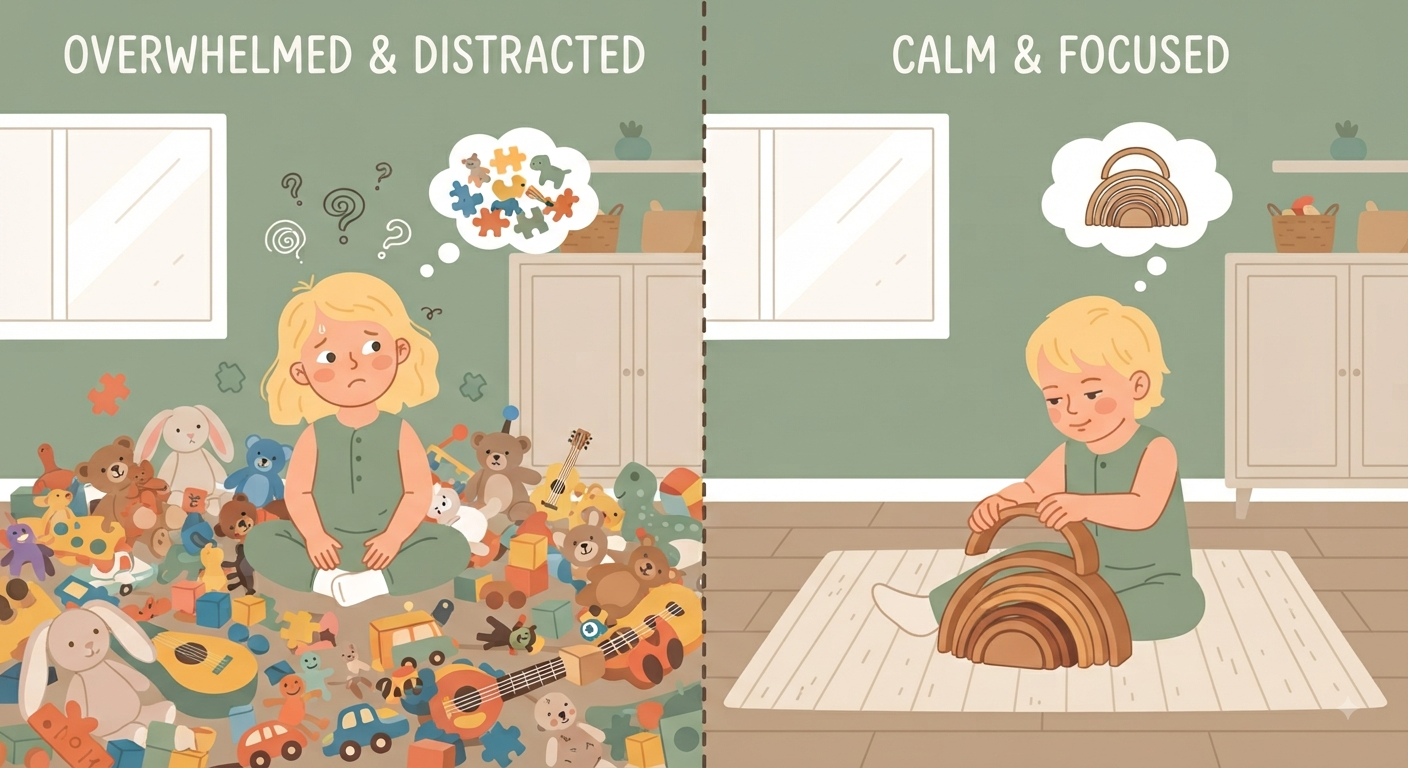
The problem with having too many toys is that kids often get stuck in exploration mode, bouncing from item to item, never settling in long enough to reach that second, richer stage. With fewer options, children move through exploration faster and spend far more time in the play stage — which is where the real developmental magic happens: creativity, initiative, adaptability, and imagination.
Child development specialists have also pointed out that when children are surrounded by too much stimulation, they can become overwhelmed to the point of shutting down entirely — unable to concentrate on any one thing long enough to actually learn from it. Fewer choices, paradoxically, create more room for a child’s mind to actually engage.
It’s Not Just About Toy Count — It’s About Type, Too
This isn’t only about quantity. The kind of toys matters just as much. Simpler, more open-ended toys — blocks, dolls, art supplies, kitchen sets — tend to invite more imaginative play than toys with a single fixed function, flashing lights, or built-in sounds. A toy that does everything for a child often leaves less for the child’s own imagination to do.
There’s a well-known example from a German public health experiment where researchers convinced a kindergarten classroom to remove all their toys for three months. At first, boredom set in and kids didn’t quite know what to do with themselves. But before long, the children began inventing their own games using nothing but their basic surroundings — chairs became forts, blankets became capes, and imagination filled the space toys used to occupy.
The Toy Rotation Trick
If the idea of getting rid of toys altogether feels overwhelming (or like it would start a full-blown meltdown in your house), you don’t have to go that far. One simple, low-stress approach that researchers point to is toy rotation.
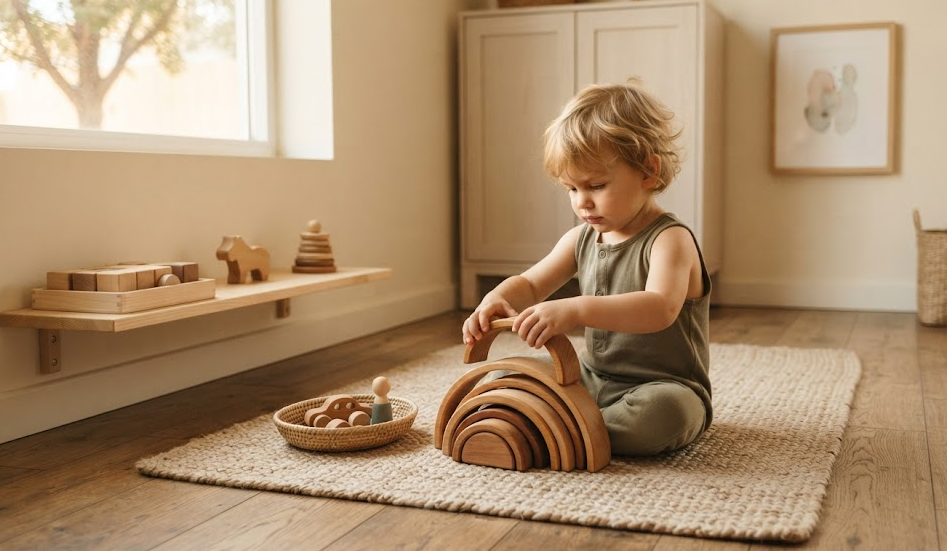
Instead of having every toy accessible at all times, keep a smaller selection out and store the rest away. Every couple of weeks, swap the toys out. This gives kids the sense of novelty and excitement of a “new” toy — without you having to buy anything new — while still keeping the play environment simple enough for deep, focused engagement.
What This Means for Your Home
You don’t need an empty, sparse playroom to see the benefits here. It’s less about achieving some minimalist aesthetic and more about protecting your child’s attention and giving their imagination room to actually stretch.
A few practical starting points:
- Start small. Pick one bin or shelf and pare it down before tackling the whole room.
- Prioritize open-ended toys. Blocks, play silks, dolls, art supplies, and pretend-play sets tend to hold attention longer than single-function toys.
- Rotate rather than eliminate. Store extras out of sight and swap them in periodically.
- Involve your child when they’re old enough. Even young kids can help choose a few toys to “take a break” and go into a bin for later.
- Let go of the guilt. Having fewer toys out doesn’t mean your child has less — it often means they get more out of what they already have.
The Bottom Line
More toys doesn’t mean more fun, more learning, or more happiness — often it means the opposite. When children have fewer choices in front of them, they slow down, focus in, and let their imagination do the heavy lifting instead of the toy itself. The next time your living room floor disappears under a pile of plastic, it might not be a sign you need to buy an organizer. It might be a sign it’s time to put some of it away — for your child’s sake, and honestly, for your sanity too.