

In this article
You’re in the grocery store. Your toddler wanted the red cup, you handed them the blue one, and now they’re on the floor, screaming, kicking, completely inconsolable. Someone nearby gives you that look. You feel your face go hot. And somewhere in your head, a voice says: I need to get control of this. I need to discipline this.
Here’s the thing — what’s actually happening in your toddler’s brain in that moment has almost nothing to do with defiance, manipulation, or bad behavior. And once you understand what’s really going on biologically, traditional discipline starts to look less like a solution and more like a mismatch for what your child actually needs.
What’s Really Happening in a Toddler’s Brain During a Meltdown
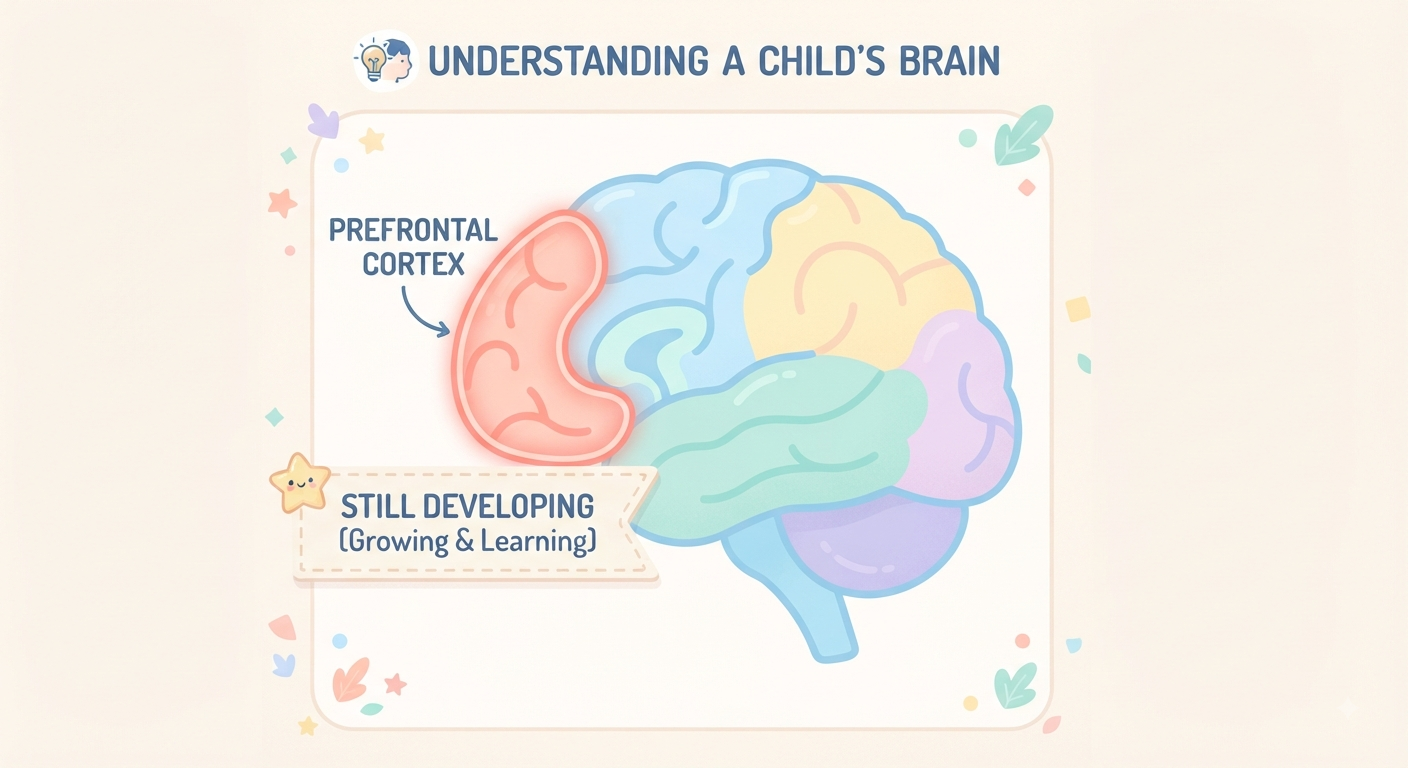
The part of the brain responsible for reasoning, impulse control, and managing big emotions is the prefrontal cortex — and it is nowhere near finished developing in a toddler. Because young children haven’t yet developed the impulse control and inhibition functions tied to the prefrontal cortex, they often can’t manage their emotions through logic or reasoning in the moment. One child psychiatrist describes it like a pot of boiling water, with the prefrontal cortex acting as the lid — and in a toddler, that lid simply isn’t strong enough yet to hold everything in.
This isn’t a character flaw. It’s architecture. Toddlerhood is actually one of the most rapid periods of brain development in a person’s entire life, with hundreds of new neural connections forming every second — which helps explain why big emotions and difficult behavior show up so intensely at this age.Deep in the brain, the amygdala and prefrontal cortex work together to support reasoning and emotional regulation, but that system is still very much under construction in a young child, and it only gets stronger with time and experience
In other words: your toddler isn’t choosing to fall apart over the color of a cup. Their brain genuinely cannot regulate that flood of frustration yet.
Tantrums vs. Meltdowns — And Why the Difference Matters
Parents often use “tantrum” and “meltdown” interchangeably, but there’s a meaningful distinction worth knowing.
A tantrum tends to have a purpose — it’s usually aimed at getting a desired outcome, and once that goal changes or is addressed, the behavior tends to fade. A meltdown is different. A meltdown doesn’t have a clear starting trigger in the same way — it often builds from sensory overload, and the child becomes unable to process further instruction until their nervous system has time to settle back down.
Both are developmentally normal. Temper tantrums and emotional meltdowns are a normal developmental characteristic of toddlerhood, closely tied to physical and emotional immaturity along with still-developing language and cognitive skills.Your child isn’t broken, and neither is your parenting, just because these moments happen — often — during this stage.
Why Traditional Discipline Often Backfires Here
Traditional discipline approaches — time-outs, stern lectures, “because I said so,” punishment for the outburst itself — tend to assume a child is capable of stopping and thinking it through. But during a meltdown, that capability simply isn’t online yet.
Children haven’t yet developed the ability to manage their emotions through appeals to logic, which means trying to reason with a toddler mid-meltdown rarely works the way it would with an older child or adult. Lecturing, threatening consequences, or demanding they “calm down” during the peak of the storm is asking a brain to do something it isn’t physically equipped to do yet — like asking someone to solve a math problem while they’re drowning.
This is also why manipulation isn’t really the right lens. Toddlers cannot be intentionally manipulating you when they cry, because manipulation requires planning and strategy — functions that live in the prefrontal cortex, the very part of the brain that isn’t mature enough yet to pull that off.
None of this means there should be no guidance or limits — quite the opposite. It means the timing and method of that guidance matters enormously.

What Actually Helps, According to the Research
Connection before correction. Current research consistently frames challenging behavior as a form of communication rather than defiance, and emphasizes that when adults understand the developmental reasons behind tantrums and respond with evidence-based approaches, children build real skills in emotional regulation, problem-solving, and social competence.
Meltdowns aren’t just something to survive — they’re something to move through together. Toddlers build up stress hormones as they navigate daily challenges, and a meltdown is, in a sense, the body’s own way of releasing that overload — not a manipulation tactic, but a physiological release valve their conscious mind isn’t controlling.
Discipline and punishment aren’t the same thing. The word discipline actually comes from “disciple,” meaning to teach and guide by example — which is a very different posture than punishment, which tends to communicate that a child is bad rather than that they’re struggling with a feeling they can’t yet manage.
Structure still matters. None of this is a case for permissiveness. Toddlers genuinely benefit from consistent routines, predictable limits, and calm, repeated guidance — they just respond to guidance far better once their nervous system has settled, not while it’s still spiking.
Know when it’s more than typical. Temper tantrums are a normal part of early childhood development, but if a child continues having regular, major meltdowns past around age five, it can sometimes point to something more — often related to difficulty filtering or processing sensory input, which can show up alongside ADHD, anxiety, sensory processing differences, or autism. If you’re noticing that pattern, it’s worth a conversation with your pediatrician — not as a discipline issue, but as a developmental one.
So What Do You Actually Do in the Grocery Store?
Get down to their eye level if you can. Keep your own voice low and steady — your calm nervous system helps regulate theirs, even if it doesn’t look like it’s working in the moment. Name the feeling (“You really wanted the red cup”) without necessarily changing the outcome. Skip the lecture until later — there’s no version of a toddler mid-meltdown that’s ready to absorb “we don’t act like this in public.”
And afterward, once things are calm? That’s when the teaching actually lands. That’s when a short, gentle conversation about what happened can actually reach them, because their prefrontal cortex is back online enough to participate.
The Bottom Line
Your toddler’s meltdowns aren’t a referendum on your parenting, and they’re not a sign your child is manipulative, spoiled, or “bad.” They’re a normal, biologically-driven part of a brain that’s building itself at an extraordinary pace — one that simply hasn’t finished wiring up the parts responsible for staying calm under pressure.
Traditional discipline, built around correction and consequence in the heat of the moment, asks toddlers for a skill they don’t have yet. Meeting them with connection first — and saving the teaching for after the storm passes — works with their biology instead of against it. And honestly, it tends to be a lot less exhausting for you too.